
Navigating the Global Market for Imported Food Packaging Bags
In the modern food manufacturing ecosystem, purchasing agents, packaging engineers, and supply chain directors face a dual challenge: lowering per-unit packaging overhead while meeting uncompromising food safety standards and shelf-life requirements. Importing food packaging bags offers substantial economies of scale, but procuring flexible barrier bags overseas without a domestic risk-mitigation infrastructure introduces critical vulnerabilities—such as variable oxygen barrier performance, delamination risks, and FDA customs holds.
At American Packaging Solutions (APS), we bridge the gap between overseas manufacturing efficiency and North American reliability. Operating since 2001 with corporate headquarters in Brooklyn, NY, and strategic logistics hubs in New Jersey, Illinois, and California, APS acts as both a certified manufacturer and a premier importer of food grade flexible packaging. Whether your product line requires high-barrier metallized stand-up pouches, retort-capable liquid bags, or automated rollstock film, understanding material physics, regulatory mandates, and total cost of ownership (TCO) is essential for profitable growth.
Not all imported flexible packaging films provide equal protection against organoleptic degradation. Oxygen Transmission Rate (OTR) and Water Vapor Transmission Rate (WVTR) directly govern product freshness, rancidity rates, and crispness retention. Below is a technical benchmark comparison compiled by APS packaging specialists for common multi-layer packaging structures used in imported food bags.
| Film Layer Structure | Typical Thickness | OTR (cc/m²/24hr @ 23°C, 0% RH) | WVTR (g/m²/24hr @ 38°C, 90% RH) | Primary Food Applications |
|---|---|---|---|---|
| PET / AL / LLDPE | 110 – 140 µm | < 0.05 (Maximum Barrier) | < 0.05 (Maximum Barrier) | Freeze-dried foods, powdered milk, specialty coffee, long shelf-life items |
| PET / VMPET / LLDPE | 90 – 120 µm | < 0.50 | < 0.50 | Snack foods, roasted nuts, granola, pet food treats, dried fruit |
| PET / EVOH-PE | 80 – 110 µm | < 0.80 | < 1.20 | Clear window snack pouches, fresh bakery products, organic pasta |
| High-Barrier Mono-PE (MDO-PE/PE+EVOH) | 90 – 130 µm | < 1.00 | < 1.50 | 100% Recyclable store drop-off pouches, eco-conscious retail products |
Regulatory Compliance: Navigating FDA 21 CFR & Import Customs
When importing food packaging bags into North America, compliance cannot be assumed. The U.S. Food and Drug Administration (FDA) strictly regulates all Food Contact Substances (FCS) under 21 CFR § 177 (indirect food additives: polymers, adhesives, and colorants). Foreign suppliers failing to provide heavy metal screening (CONEG / Toxics in Packaging legislation) or solvent residue verification (via Gas Chromatography analysis) risk severe product seizures, port redelivery notices, and catastrophic brand reputational damage.
APS mitigates these risks by subjecting every imported production run to rigorous dual-testing protocols. Our overseas facilities are ISO 22000 and BRCGS (British Retail Consortium Global Standards) certified, ensuring full hazard analysis critical control point (HACCP) alignment. Furthermore, our domestic quality control laboratory in Brooklyn performs seal integrity testing, COF (Coefficient of Friction) verification, and solvent retention analysis before releasing inventory to our clients.
High-Performance Imported Food Packaging Bags
Selected for exceptional barrier integrity, graphic clarity, and competitive wholesale pricing, our specialized imported packaging solutions cater to diverse commercial food manufacturing applications.

Custom High-Barrier Stand-Up Pouches
Ideal for snacks, dried nuts, confectioneries, and specialty grains. Featuring press-to-close (PTC) tear zippers, tear notches, and high-clarity windows, these pouches provide maximum shelf visibility alongside robust environmental shielding.
Flexible Form-Fill-Seal (FFS) Rollstock
Precision-engineered for high-speed automated vertical and horizontal packaging machinery. Features tight web tension control, uniform sealant layer thickness, and low hot-tack initiation temperatures for zero-defect sealing.
Flat-Bottom & Quad-Seal Retail Bags
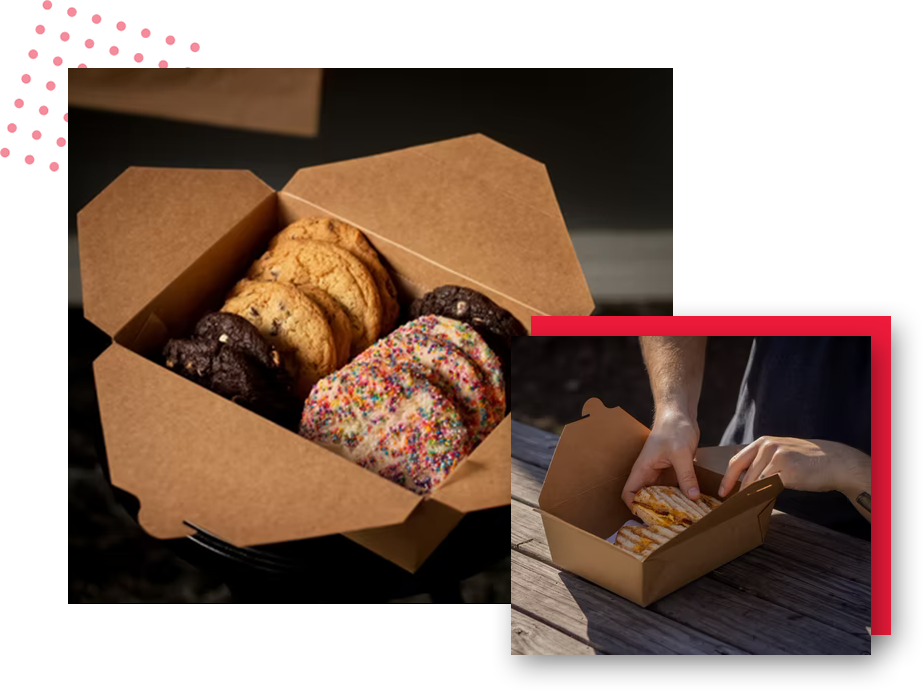
Combining the structural stability of a box with the weight efficiency of flexible film. Flat-bottom bags offer five distinct printable panels for high-impact brand messaging, premium retail positioning, and maximum volumetric efficiency.
High-Barrier Retort & Spouted Pouches
Engineered to withstand thermal processing up to 135°C (275°F) for shelf-stable liquid and wet foods. Replaces rigid tin cans and glass jars, slashing transportation freight costs by up to 60%.
Future Procurement Trends in Imported Food Bags (2026–2030)
The global procurement landscape for flexible packaging is undergoing a structural evolution. Shifts in international trade policy, ocean freight volatility, and stringent state-level environmental mandates in North America require procurement executives to move beyond transactional purchasing to resilient strategic frameworks.
1. Hybrid "Offshore + Domestic Warehousing" Model
Relying purely on direct-to-factory ocean shipments leaves food manufacturers vulnerable to port congestion and shipping delays. Leading brands are adopting APS's hybrid procurement model: leveraging competitive overseas production costs while maintaining 60–90 days of safety stock in US regional warehouses (NJ, IL, CA) for on-demand 48-hour release.
2. Legislative Drivers & EPR Mandates
Extended Producer Responsibility (EPR) laws across California (SB 54), Oregon, and Europe are penalizing unrecyclable non-separable multi-layer laminates. The market is rapidly shifting toward imported mono-material flexible structures (PE/PE or PP/PP) engineered with high-barrier EVOH, enabling complete post-consumer recycling without sacrificing barrier properties.
3. Digital Traceability & Smart Packaging
Future imported food packaging bags are embedding digital DNA—such as unique GS1 Digital Link QR codes, invisible watermarking (Digimarc), and anti-counterfeiting micro-features. This enables end-to-end supply chain visibility, automated customs verification, and interactive consumer transparency regarding ingredient origin.
Calculating the real value of imported food packaging requires looking beyond FOB plant prices. The true Total Cost of Ownership (TCO) includes:
TCO = Direct Unit Price + Ocean Freight/Tariffs + Customs Clearance Fees + Domestic Storage Costs + Quality Defect Risk Buffer
APS's domestic warehousing and rigorous pre-shipment quality assurance eliminate unexpected demurrage charges and defective lot costs, guaranteeing predictable land-cost margins for enterprise clients.
Technological Development Trends in Food Grade Film Polymers
As polymer science advances, imported flexible packaging bags are achieving unprecedented technical milestones. Manufacturers are replacing legacy aluminum foil layers with ultra-thin vacuum-deposited ceramic coatings and bio-based barrier resins.
1. Silicon Oxide (SiOx) & Aluminum Oxide (AlOx) Transparent Barriers
Historically, reaching ultra-low OTR (< 0.1 cc/m²/24hr) required an opaque aluminum foil core (PET/AL/PE). Modern foreign extrusion facilities utilized by APS employ electron-beam physical vapor deposition to apply microscopic SiOx or AlOx ceramic layers onto PET films. This creates crystal-clear food pouches that deliver foil-grade gas protection while remaining fully microwaveable and metal-detector compatible on production lines.
2. Electronically Controlled Rotogravure & Solvent-Free Lamination
The transition from solvent-borne adhesives to 100% solvent-free aliphatic polyurethane laminating systems ensures zero residual volatile organic compound (VOC) migration into sensitive food matrices. Combined with automated cylinder engraving running at 150 LPI (lines per inch), imported packaging bags deliver photorealistic imagery, precise color matching (Delta E < 1.5), and zero chemical odor.
3. Active MAP (Modified Atmosphere Packaging) Technologies
Next-generation imported pouches incorporate active moisture-scavenging inner sealant layers and oxygen absorber masterbatches directly into the PE matrix. This actively neutralizes headspace oxygen post-sealing, extending the freshness of delicate dry foods like organic milk powders, roasted coffee beans, and dehydrated snacks without chemical preservatives.

Enterprise Strengths & Proven Industry Authority
For over two decades, American Packaging Solutions (APS) has served as a cornerstone flexible packaging partner for North America's leading food corporations, regional brands, and dynamic startups. Our operational blueprint is built on four core pillars of authority, reliability, and technical excellence.
20+ Years Sourcing Mastery
Founded in 2001 in Brooklyn, NY, APS brings deep domain expertise in polymer science, international trade regulations, and food safety protocols. We have navigated decades of supply chain shifts to consistently deliver cost savings to our partners.
PepsiCo Approved Vendor
Our manufacturing processes, quality control audits, and ethical sourcing standards have earned approval from global food giants like PepsiCo. We adhere strictly to global food safety initiatives (GFSI) and BRCGS food safety standards.
4 Strategic US Logistics Hubs
With operational headquarters in Brooklyn, NY and massive regional distribution warehouses across New Jersey, Illinois, and California, we mitigate container delay risks and provide vendor-managed inventory (VMI) services nationwide.
Frequently Asked Questions (FAQ)
Addressing the top technical, regulatory, and supply chain inquiries from purchasing managers and packaging engineers regarding imported food packaging bags.